
 Muhammad Muaz
 Does your front yard have a noticeable slope or hill? If you’ve been viewing it as a landscaping challenge or eyesore, it’s time to change your perspective. Hills and sloped yards aren’t limitations – they’re opportunities to create dramatically beautiful, visually interesting landscapes that flat yards simply cannot achieve. Throughout history, some of the world’s most stunning gardens have been built on hillsides, from terraced vineyards in Italy to dramatic Japanese mountain gardens. Your front yard hill can become a genuine asset that increases curb appeal, creates visual interest, and even improves drainage and functionality.
This comprehensive guide presents 22 proven front yard hill landscaping ideas that transform slopes into showcase features. Whether you’re dealing with a gentle slope or a dramatic grade change, whether your hill faces sun or shade, whether you want to embrace the natural topography or create defined terraces, you’ll find solutions here. These ideas range from low-cost, DIY-friendly options to more elaborate hardscaping projects, allowing you to work within your budget and timeline. The result? A front yard that makes visitors pause and admire, a landscape that functions beautifully while looking stunning, and a property value boost that reflects your dramatic curb appeal. Let’s turn that challenging slope into your yard’s most compelling feature!
1. Terraced Garden Beds:
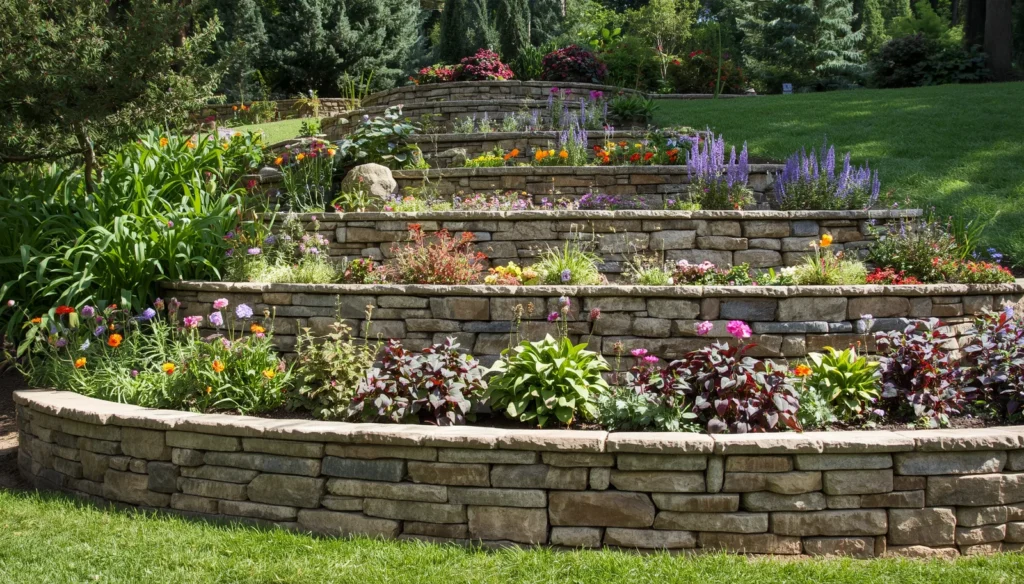
Terraced garden beds transform sloped yards into sophisticated, structured landscapes that look professionally designed while dramatically improving functionality. By creating level planting areas with retaining walls at different elevations, you solve drainage challenges, create multiple planting zones, and add incredible visual depth and dimension. Each terrace level becomes a separate planting opportunity, allowing you to grow different plants with varying light and water needs on the same hill. Terraces also create natural gathering points and visual stopping places as the eye moves up the slope, making your landscape feel intentional and designed. The stepped effect naturally draws attention upward, making your home appear larger and more imposing – a huge curb appeal advantage.
Building terraces requires proper engineering to ensure stability, adequate drainage, and longevity, but the effort is worthwhile. You can use various materials for retaining walls – natural stone, stacked timber, composite materials, or concrete blocks – each creating different aesthetic effects. Fill each terrace with quality topsoil amended with compost, and you’ve created ideal conditions for plants to thrive. Plant the top terrace with taller specimens, middle terraces with mid-sized plants, and lower terraces with groundcovers or cascading plants to create a cohesive, layered appearance. Terraces not only solve slope problems but create landscapes that look like they belong in magazines, dramatically increasing property value and curb appeal.
2. Retaining Walls With Integrated Planting:
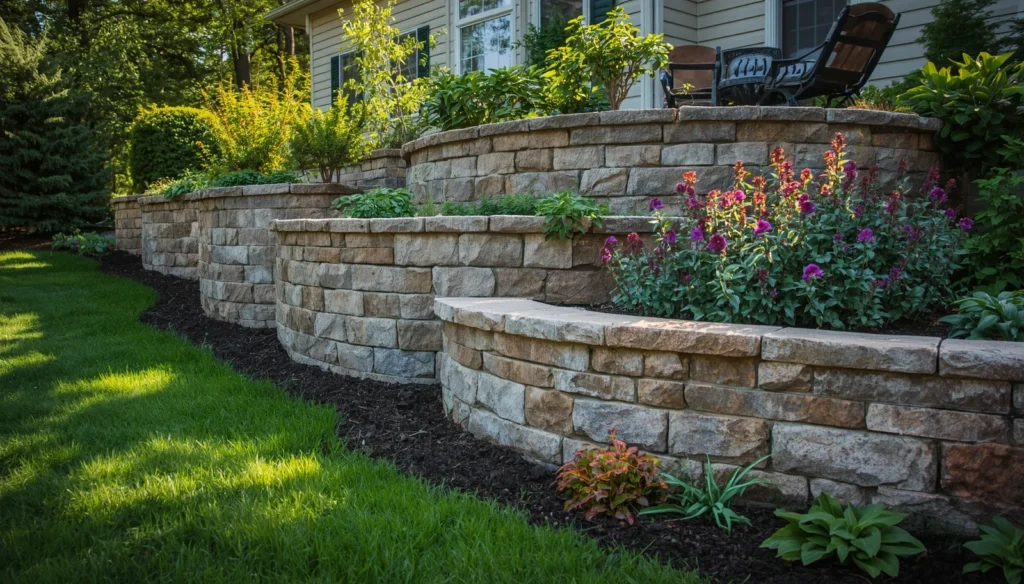
Retaining walls are essential for managing slopes, but they don’t need to be purely functional – integrating plantings directly into and around walls transforms them into beautiful landscape features. Trailing ground covers cascading down wall faces soften hard edges and add colour. Perennials planted at wall bases create transitions between the cardsharper and surrounding landscape. Some specialist retaining walls feature pockets or planting openings specifically designed to accommodate living plants, creating living walls that combine structural integrity with natural beauty. These integrated designs solve practical problems while creating visual interest, texture, and the impression of a well-established, mature landscape.
When planning retaining walls with integrated plantings, select plants appropriate to growing conditions – sun-loving specimens for south-facing walls, shade-tolerant varieties for north-facing walls. Ensure adequate soil depth for roots and proper drainage to prevent water logging. Serum and ground cover varieties work beautifully in wall pockets and cascading situations, as do ivy varieties, creeping phlox, and other tough, low-growing plants. Consider drought-tolerant selections if your region experiences dry periods, as plants in walls often experience harsher growing conditions than ground-level plantings. The combination of solid structure and living plants creates landscapes that feel both designed and naturally abundant.
3. Tiered Deck or Patio Design:
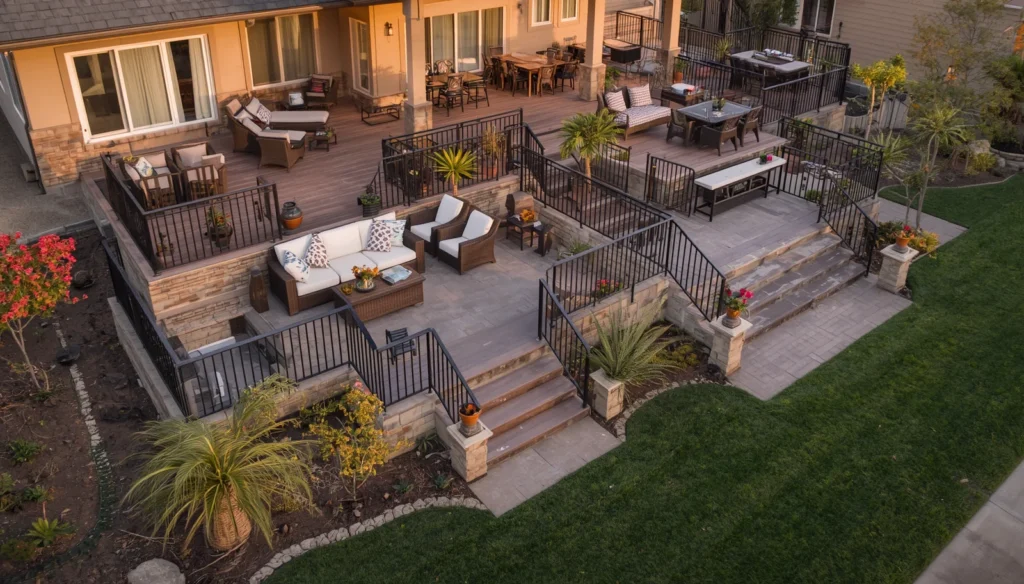
Tiered decks and patios transform sloped yards into functional outdoor living areas while solving grade challenges beautifully. By creating level platforms at different elevations, you provide flat surfaces for gathering, entertaining, and relaxing – activities impossible on steep slopes. Each deck or patio level can serve different purposes: perhaps an upper deck near the house for dining, a middle level for seating and conversation, and a lower level for gardens or additional features. This approach turns unusable slope into valuable living space while creating sophisticated, resort-like environments that dramatically increase property value and usability.
Designing tiered outdoor spaces requires careful planning regarding safety, drainage, transitions between levels, and proper engineering. Wide stairs or gently graded ramps connect levels safely and accessibly. Each platform level should have adequate space for intended purposes – minimum 12-15 feet for a dining area, for example. Integrate plantings around decks to soften hardscape edges and create natural transitions. Consider shade structures like pergolas on upper decks, and lighting to extend usability into evening hours. The result is a front yard that’s not just beautiful but genuinely functional, encouraging outdoor living and dramatically enhancing your daily enjoyment of your property.
4. Cascading Water Features:
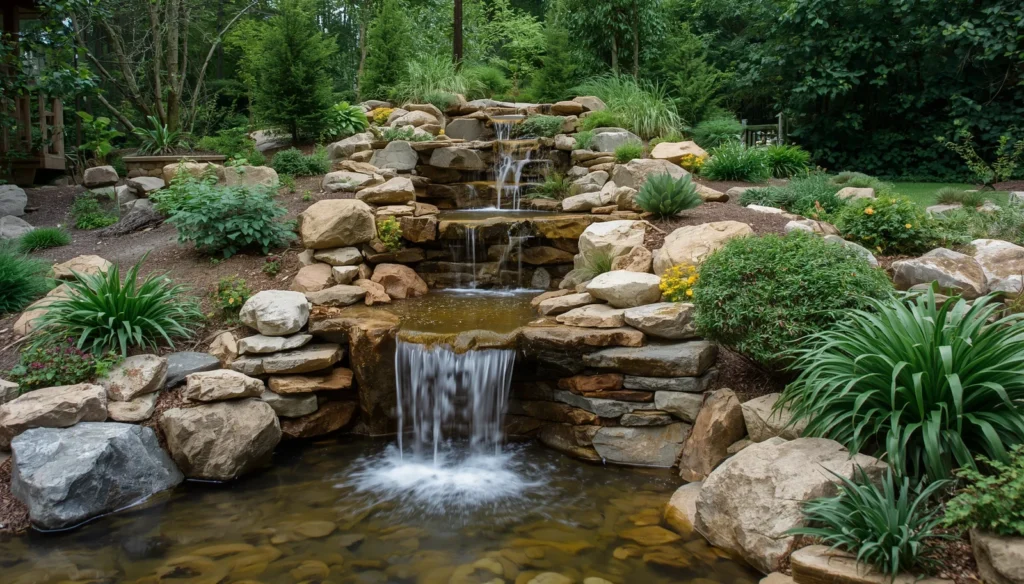
Slopes provide perfect opportunities for cascading water features – waterfalls, streams, and fountains that utilize gravity to create movement, sound, and visual interest. Natural cascading water is infinitely more interesting than static water features, and the sound of flowing water masks street noise while creating peaceful ambiance. Water features draw the eye, create focal points, and add sensory richness to landscapes. Even modest cascading fountains positioned strategically on slopes transform yards into serene retreats. These features work beautifully whether your aesthetic is contemporary, naturalistic, Asian-inspired, or traditional – customizable designs fit any style.
Installing cascading water features requires adequate water source, proper drainage, and usually a recirculating pump system. Professional installation ensures proper slopes, stable construction, and adequate water circulation. You can create naturalistic effects with stone and rocks, or more contemporary designs with modern materials. Position features where you can enjoy them from inside your home as well as from your yard, multiplying their value. Integrate plantings around water features with moisture-loving varieties like hostas, ferns, and tropical plants that thrive in humid microclimates created by splashing water. The combination of moving water, lush plantings, and the sound of cascading water creates landscapes that feel genuinely special.
5. Rock Gardens and Alpine Plants:
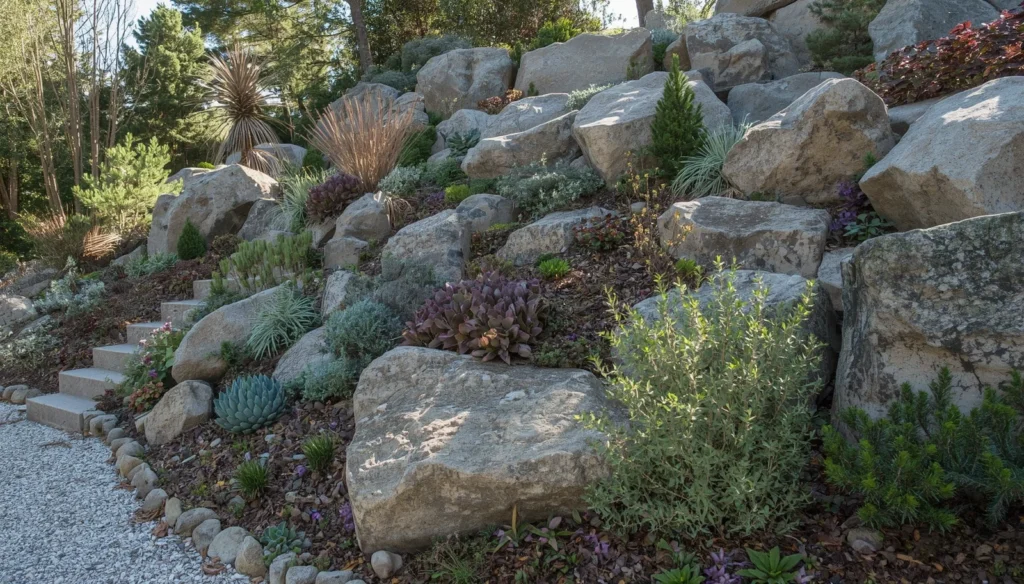
Rock gardens are perfect for slopes, utilizing natural drainage and elevation to create ideal growing conditions for alpine and rock garden plants. These specialized gardens showcase unusual plants that thrive in well-drained, sunny conditions – the exact conditions slopes naturally provide. Positioning large boulders strategically creates visual interest while providing soil pockets for alpine plants. The result feels naturally elegant – like a piece of mountain landscape right in your front yard. Rock gardens require less maintenance than traditional gardens because plants are selected for the site conditions rather than trying to modify conditions for plants.
Building rock gardens starts with careful boulder positioning – large stones should appear naturally placed rather than randomly scattered. Create planting pockets with special alpine soil mixture that’s extremely well-draining, as these plants evolved in high-mountain environments with minimal soil and intense drainage. Select from the incredible variety of alpine plants: sedums, sempervivums, saxifrages, dwarf conifers, and alpine perennials that offer year-round interest in miniature. The rocky terrain and specialized plants create a sophisticated landscape that feels both designed and naturally abundant. Rock gardens are also remarkably low-maintenance once established, requiring minimal water, fertilizing, or pest management.
6. Steps and Pathways:
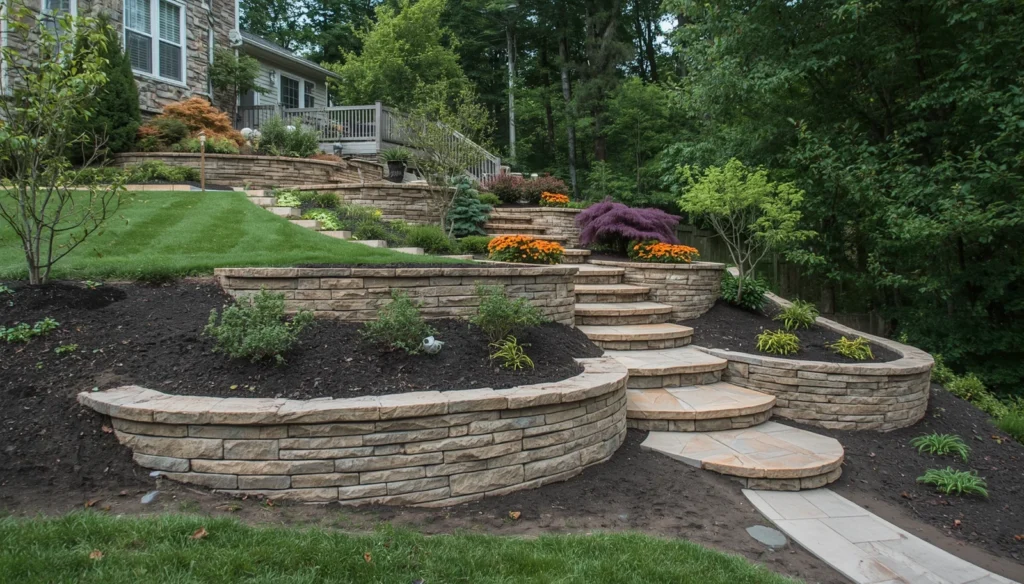
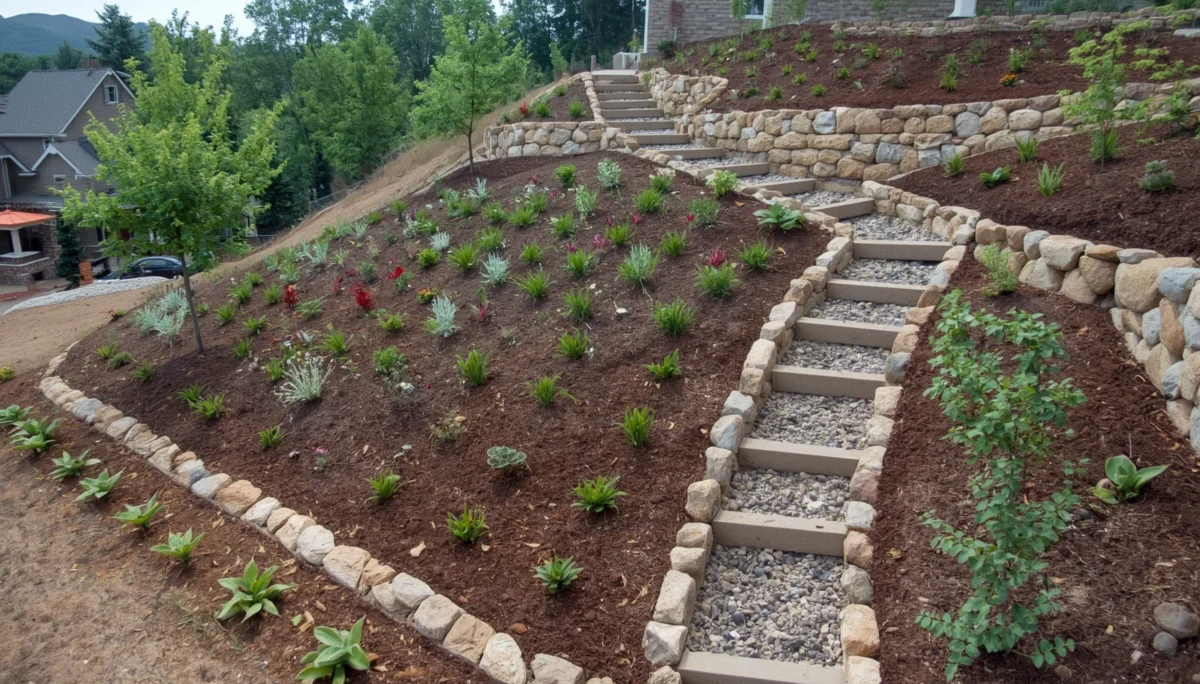
Functional steps and pathways are essential for safely navigating slopes while also serving as powerful design elements. Well-designed stairs draw the eye upward and create visual interest, while also providing practical access to all areas of your yard. Natural stone steps feel organic and beautiful, while composite or manufactured options offer consistency and durability. Pathways lined with plantings guide visitors through your landscape, creating journeys rather than simple access routes. Consider wide stairs with generous treads and risers – they feel more accessible and look more attractive than steep, narrow stairs. Lighting along pathways creates safety while adding nighttime visual interest.
When designing steps and pathways for slopes, prioritise safety through adequate handrails where needed, non-slip surfaces, and proper construction. Create resting points with landings where possible to break up steep sections. Plant specimen trees or shrubs at transitions to mark important viewpoints. Line pathways with complementary plantings that guide the eye and soften cardsharper edges. Consider the sight lines from your house and from the street – pathways should draw viewers’ attention to your best features. Strategically positioned steps and pathways transform slopes from navigation challenges into features that enhance and define your landscape.
7. Slope Erosion Control With Native Ground Covers:
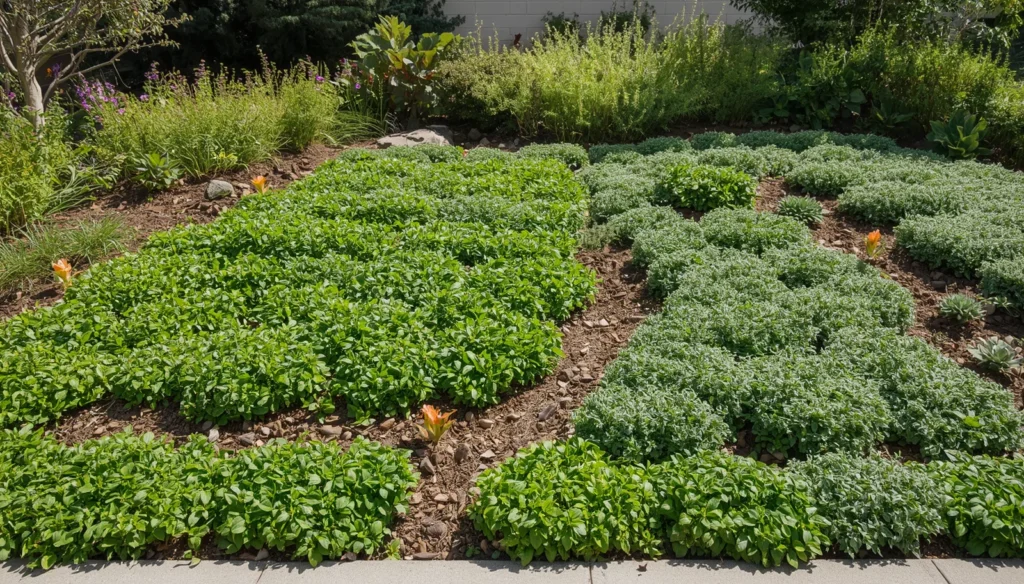
Erosion on slopes is a serious problem that also provides an opportunity – controlling erosion with beautiful native ground covers simultaneously solves practical problems and creates stunning visual effects. Native groundcovers are perfectly adapted to sloped terrain, handle drainage beautifully, stabilize soil through root systems, and require minimal maintenance. A densely planted slope becomes a self-maintaining erosion control system that’s infinitely more attractive than exposed soil, erosion fabric, or hardscaping. These plants also support local pollinators and wildlife, turning a problem area into an ecological asset.
Selecting appropriate native ground covers depends on your region, light exposure, and soil conditions. Cool-region slopes might feature creeping juniper, native sedge, or regional ground-covers. Warm climates offer options like native grasses, sledges, and regional species. Densely planted ground covers may require initial attention – regular watering during establishment, careful weeding to prevent competition – but once established, essentially care for themselves. They spread naturally, prevent erosion, and require minimal maintenance beyond occasional trimming to maintain appearance. A hillside transformed from bare, eroding soil into lush native plant community becomes a genuine asset – beautiful, functional, and ecologically valuable.
8. Specimen Tree Placement:
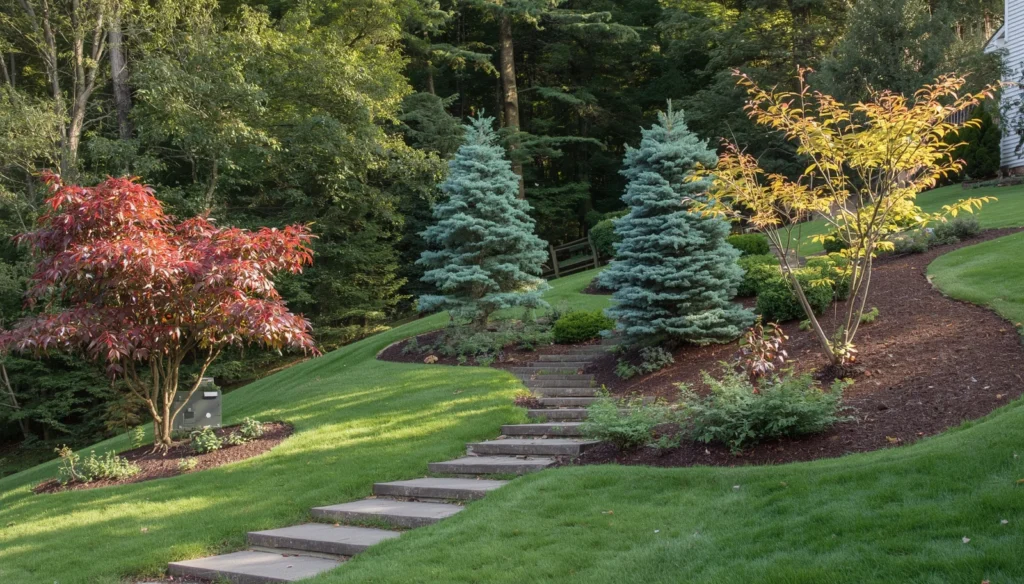
Slopes provide perfect opportunities to showcase specimen trees – those special plants chosen for dramatic form, color, or seasonal interest. Positioned on slopes, trees gain additional prominence as elevation naturally highlights their structure. A Japanese maple on a slope appears more dramatic than on flat ground. Weeping forms of trees become landscape focal points. Ornamental conifers with unusual colors or forms draw the eye. The key is selecting trees with genuine visual interest – not just large green specimens – and positioning them to maximize their impact. Even a single spectacular specimen tree can transform a slope from an eyesore into a landscape focal point.
When selecting specimen trees for slopes, consider mature size carefully – a tree that seems like the right size when young can become overwhelming when mature. Ensure selected varieties are hardy in your climate and appropriate for your sun and soil conditions. Position trees where they’re framed by surrounding plantings, where they’ll be visible from multiple vantage points, and where they create balanced compositions rather than awkwardly dominating views. Underplant specimen trees with complementary shrubs and groundcovers that enhance rather than compete with the trees’ forms. A well-placed specimen tree on a slope becomes a genuine focal point that visitors notice and remember.
9. Slope Lighting:
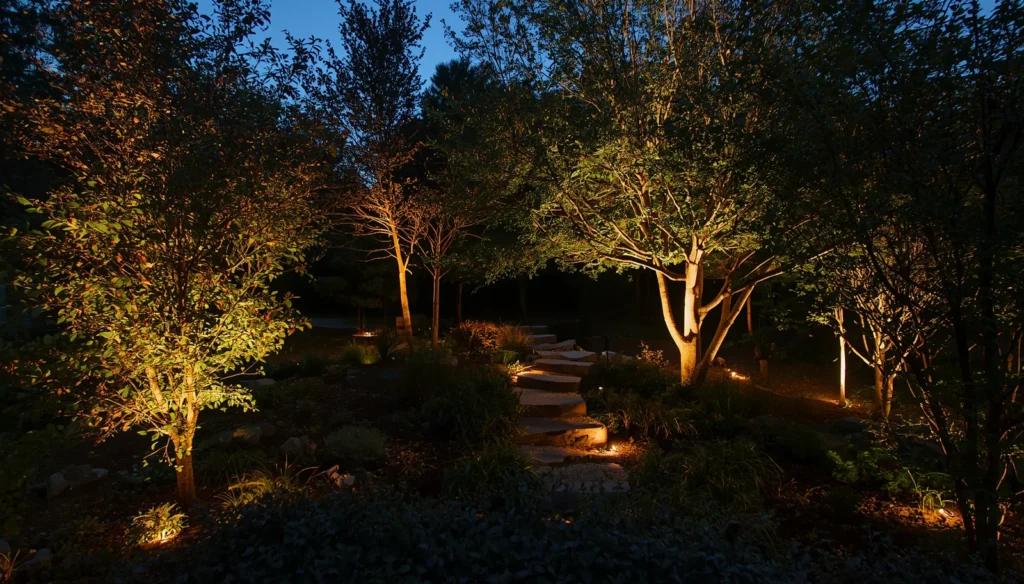
Slopes provide dramatic opportunities for landscape lighting – the elevation creates natural drama that flat yards cannot achieve. Uplighting tall plants and trees from below creates shadows and highlights that reveal forms invisible during daylight. Lighting reveals slope topography beautifully, creating visual interest that daytime visitors might miss. Pathway lighting guides safely while creating visual interest. Well-designed slope lighting extends your enjoyment of your landscape into evening hours and creates stunning curb appeal for those passing by. Even simple accent lighting on slopes creates dramatic effects superior to equivalent lighting on flat ground.
Implementing slope lighting requires thoughtful planning regarding fixture placement, lighting angles, and warm color temperature selection. Position uplights so light sources aren’t visible – the light should seem natural and reveal landscape features beautifully. Pathway lighting should guide safety without creating harsh glare. Consider motion sensors for security and energy efficiency. Use warm color temperatures (2700K or lower) that feel inviting and natural. Solar-powered systems simplify installation and operation. Strategic lighting on slopes creates dramatic effects that flat yards simply cannot achieve, transforming your front yard after dark into a stunning showcase.
10. Layered Plantings Following Contours:
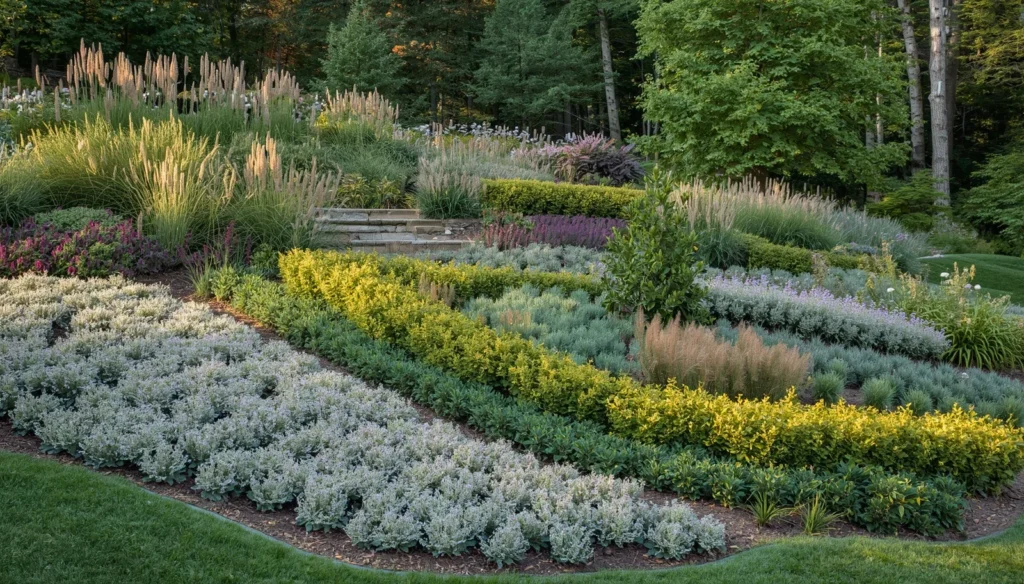
Rather than fighting a slope’s natural contours, design plantings that follow and enhance them. Tall plants at the top gradually transition to shorter specimens moving down the slope, creating flowing, natural-looking compositions. This layering approach looks infinitely more sophisticated than haphazard planting and takes advantage of the natural visual progression of elevation. Plants appear to flow down the slope like water, creating dynamic, interesting landscapes. This approach also ensures that taller plants don’t shade lower specimens, positioning plants optimally for their light requirements.
Creating naturally contoured plantings requires understanding mature plant sizes and spacing them appropriately. Begin with a rough sketch of your slope and desired plant types, then position specimens by height and mature size. Consider views from multiple vantage points – from your house, from the street, and from within the landscape. Use repetition of plant types across the slope to create unified compositions rather than random variety. Ground covers and cascading plants at the lower edge create transitions to adjacent areas. The result is a landscape that looks like it grew naturally while being carefully designed. This approach works beautifully for any plant type – perennials, shrubs, trees, or combinations.
11. Built-in Seating on Slopes:
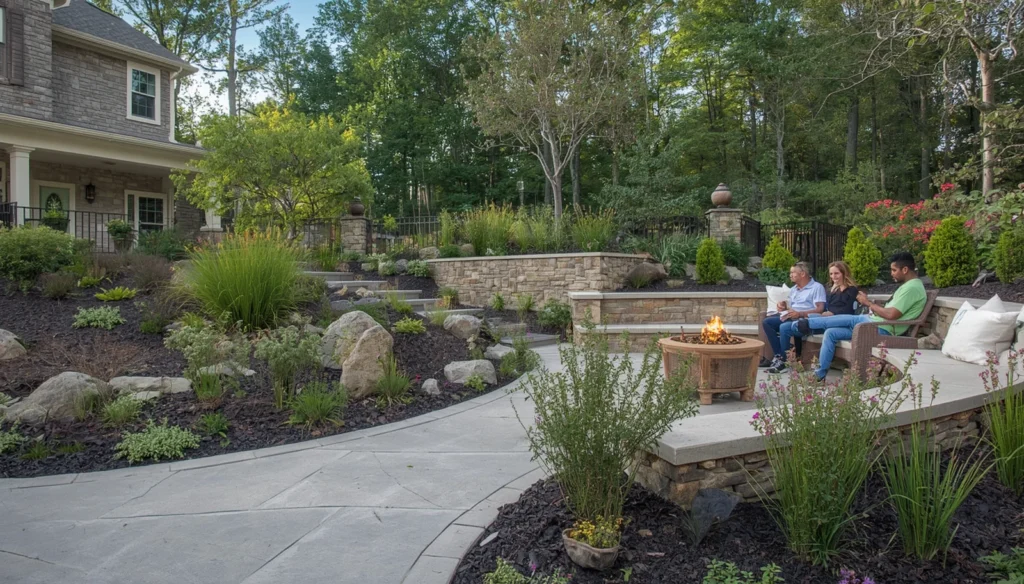
Slopes provide natural opportunities for built-in seating that utilizes slope topography ingeniously. A stone wall on a slope can serve double duty as retaining structure and seating for viewing the landscape. Log benches positioned on slopes take advantage of natural elevation. Tiered seating areas create gathering spots and viewing platforms. These features solve functional needs while becoming landscape focal points. Built-in seating transforms slopes from purely visual features into genuinely usable outdoor living spaces that encourage relaxation and gathering.
When incorporating built-in seating into sloped landscapes, prioritize comfort and safety. Benches and walls should be the appropriate height, have adequate support, and be positioned to take advantage of views or focal points. Orient seating to enjoy your best landscape features or views beyond your property. Integrate plantings around seating areas to create intimate spaces and provide shade or wind protection. Consider sightlines from the house and street – seating areas should be visible enough to be noticed and appreciated. Built-in seating transforms slopes from abstract landscape features into practical, genuine assets that enhance outdoor living.
12. Slope Terracing With Hardscape and Soundscape Combinations:
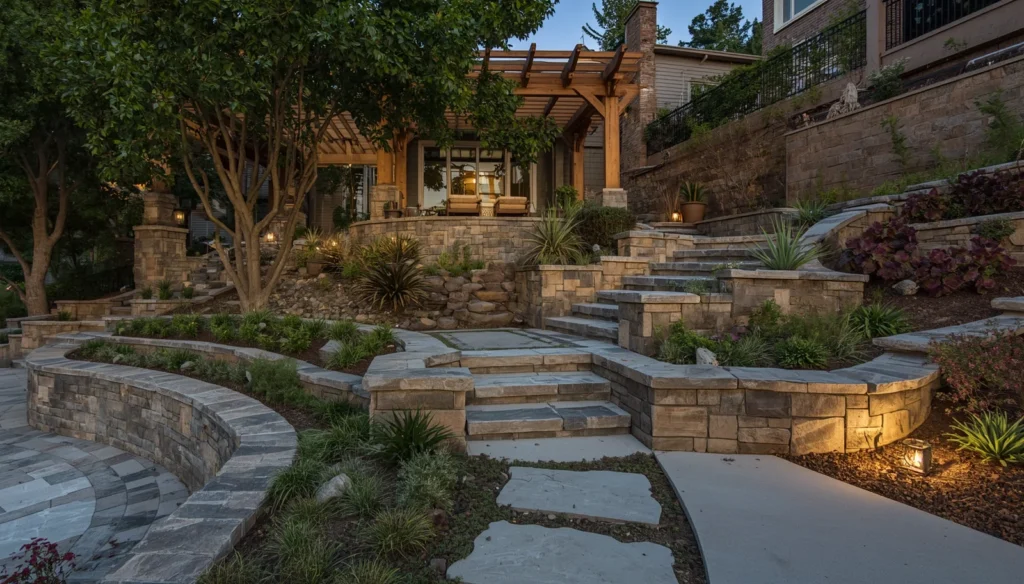
The most sophisticated slope designs blend hardscaping and softscaping seamlessly – retaining walls are softened with cascading plants, patios are framed with plantings, steps are lined with greenery. This integrated approach creates landscapes that appear designed by professionals while functioning beautifully. Rather than treating hardscape and plants separately, envision them as complementary elements working together. Hardscape provides structure and defines spaces, while plants soften edges, add color, and create living interest. The combination creates landscapes far superior to either element alone.
Creating integrated hardscape and softscape designs requires planning that considers both structural and horticultural elements simultaneously. Sketch your slope with both hardscape and planting plans. Ensure hardscaping is stable and properly engineered, and plan plantings that complement rather than hide structural elements. Use plants to transition between hardscape and natural areas, softening transitions and creating visual flow. Repetition of elements – perhaps echoing the stone tones of a wall in stone pavers and plantings – creates visual unity. Professional-looking slopes combine structure with nature, function with beauty, and thoughtful design with natural integration.
13. Ornamental Grass Plantings On Slopes:
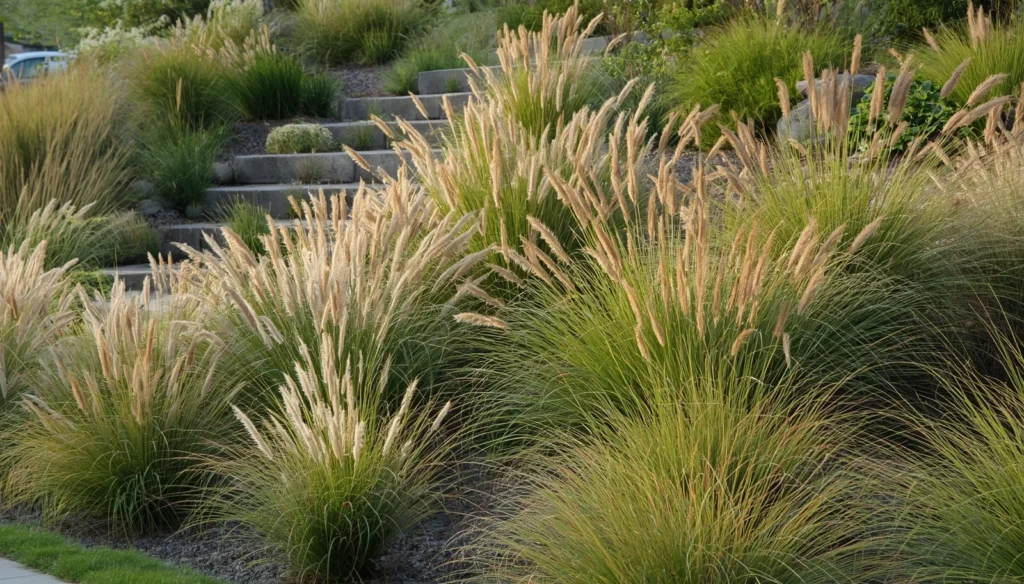
Ornamental grasses are perfect for slopes – they stabilize soil, require minimal maintenance, move beautifully in breezes, and provide year-round interest. Positioned on slopes, grasses create flowing, naturalistic designs that appear to cascade down hillsides like water. Different grass varieties offer varied heights, colors, and bloom times, allowing sophisticated color and texture combinations. Ornamental grasses also work beautifully in groups, creating flowing patterns that accent slope contours. Their movement adds liveliness to landscapes, and their feathery plumes create visual interest even after foliage dies back seasonally.
Building grass-focused slope landscapes requires understanding mature grass sizes and combining complementary varieties for year-round interest. Tall grasses like miscanthus work beautifully at slope tops, medium varieties for mid-sections, and dwarf varieties for lower edges. Combine grasses with complementary perennials and groundcovers for color and season-long interest. Spacing is crucial – proper spacing allows mature growth without overcrowding, creating flowing compositions. Most ornamental grasses need minimal maintenance beyond annual cutback in spring. A slope dominated by well-composed ornamental grass plantings becomes a sophisticated, beautiful feature that looks equally striking in winter and summer.
14. Slope Transition to Lower Lawn:
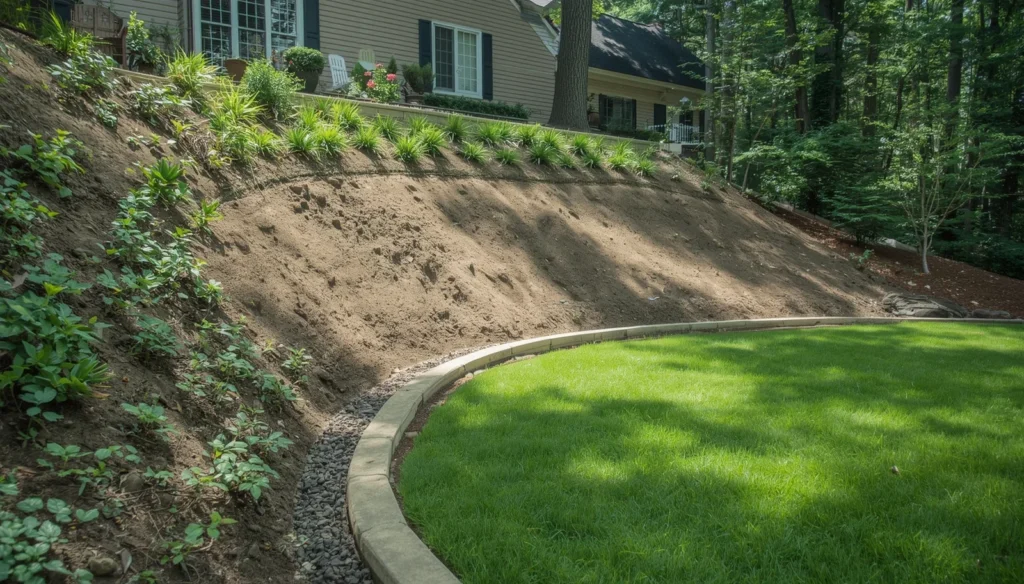
When slopes transition to lower lawn areas, managing the grade change gracefully is crucial for visual and functional success. Abrupt transitions between slope and flat areas look awkward and create drainage problems. Gradual transitions with thoughtful plantings appear natural and handle water flow beautifully. This interface zone is critical for overall landscape success. Well-managed transitions appear intentional and designed, while poor transitions signal neglect and create visual discord. The key is viewing the transition zone as a design opportunity rather than a problem to hide.
Creating graceful transitions requires understanding water flow and establishing drainage solutions. Subtle grading changes work better than abrupt transitions. Plantings at the transition zone create visual interest and soften edges. A swale or shallow drainage channel might solve practical problems while remaining visually subtle. Consider views from both the slope and lower areas – the transition should appear balanced and appropriate from both perspectives. Appropriate turf selection for lawn areas below slopes ensures that slopes and lawns coordinate visually. Well-managed transitions between slope and lawn create cohesive, professionally designed landscapes.
15. Native Plant Communities On Slopes:
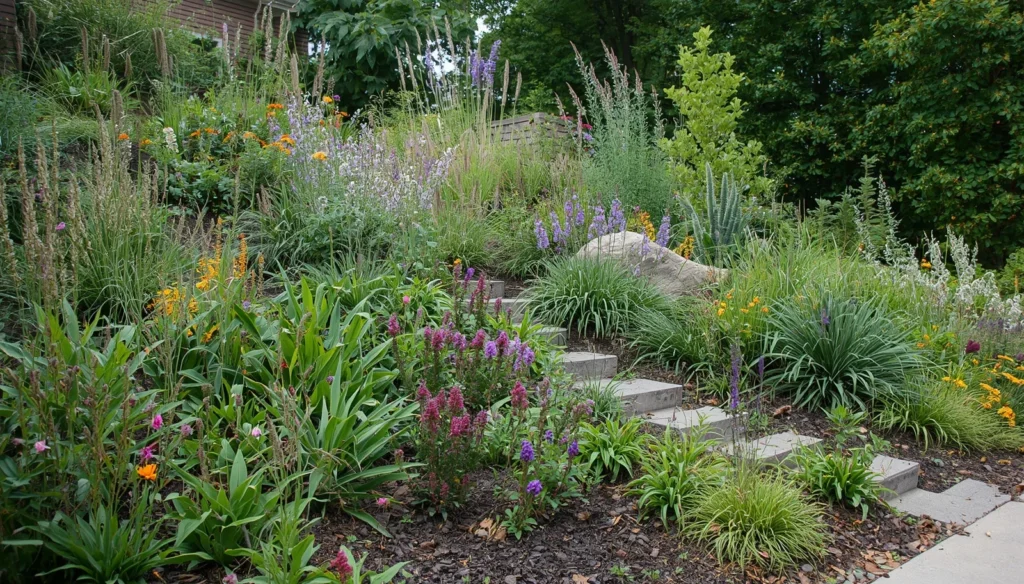
Slopes are ideal for establishing native plant communities that thrive naturally while requiring minimal maintenance. Native plants are adapted to your regional conditions, support local ecosystems, and create self-sustaining gardens that actually improve with time. A slope planted with appropriate native species becomes an asset to local biodiversity while providing year-round visual interest and requiring minimal ongoing care. Native communities also solve erosion and drainage problems naturally, making them both beautiful and practical.
Creating native plant communities starts with research into what grows naturally in your region. Visit local native plant nurseries, botanical gardens, and wild areas to see what thrives locally. Select plants appropriate to your slope’s sun exposure and soil conditions. Group plants by water needs and light requirements to create microhabitats. Include plants with varied heights, bloom times, and colors for year-round interest. Once established, native communities essentially care for themselves, spreading naturally and supporting increasingly diverse wildlife. A slope transformed into a thriving native plant community becomes a genuine asset – beautiful, functional, and ecologically valuable.
16. Slope Stabilization With Erosion Control Fabric and Strategic Plantings:
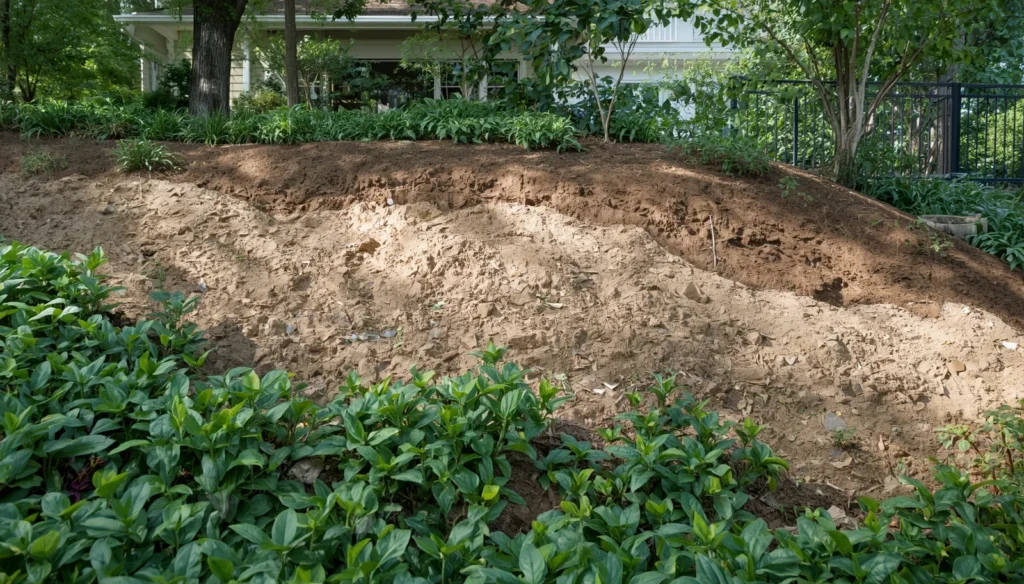
Severe erosion on slopes requires practical intervention, but solving erosion problems doesn’t mean accepting ugly solutions. Combining erosion control fabric with strategic plantings creates beautiful landscapes while solving real problems. The fabric stabilises soil while plants become established, and as plantings mature, root systems take over the stabilisation role. Properly done, erosion control can be virtually invisible – just a beautiful, healthy landscape. The key is viewing erosion control as temporary scaffolding supporting the establishment of plants that will ultimately solve the problem.
Implementing slope stabilization requires understanding water flow and selecting appropriate plants for your conditions. Erosion control fabric should be hidden – buried under soil and plants, not visible as an eyesore. Select fast-growing plants appropriate to conditions that will quickly stabilize soil and cover the landscape. Compost amendments improve native soil and support plant establishment. Once plants are established and developing root systems, maintenance becomes standard landscape care. A slope that was eroding and losing soil becomes stable and beautiful, supporting healthy plant growth and requiring minimal ongoing intervention.
17. Slope Drainage Solutions:
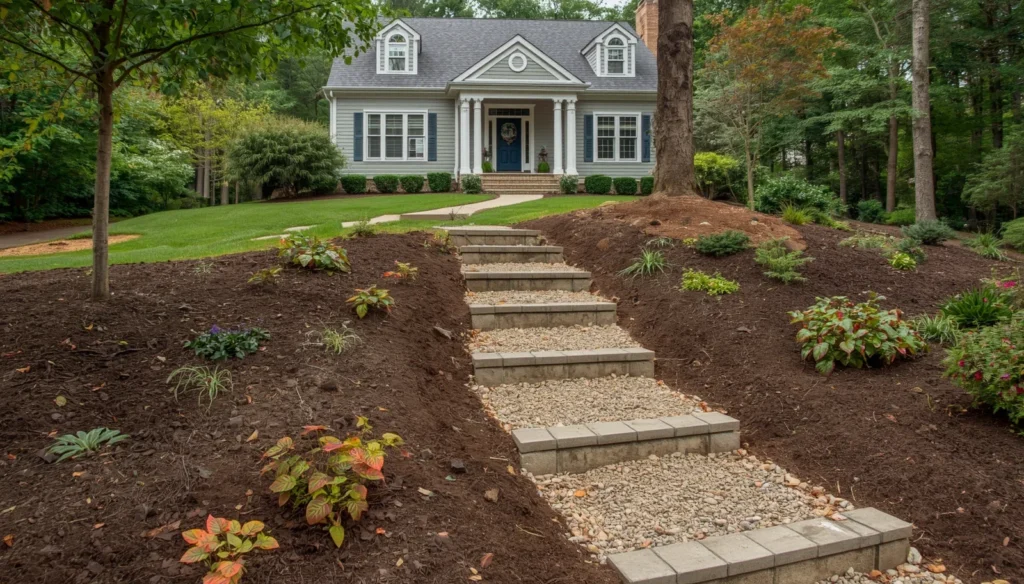
Proper drainage is essential for slope success, but drainage solutions don’t need to be ugly. Modern drainage design integrates practical water management with beautiful landscape features. French drains, swales, and drainage channels can be subtle, visually integrated elements that solve water problems while enhancing landscapes. Bio-swales – landscaped depressions that filter and direct water – become attractive landscape features. The key is designing drainage systems that function beautifully while solving practical problems.
Creating integrated drainage solutions begins with understanding water flow patterns on your slope. Identify where water concentrates and flows, then design systems to manage water safely while remaining visually attractive. A swale lined with plantings can direct water beautifully while appearing natural. Permeable surfaces allow water infiltration while remaining functional. Subtle grading and plantings can guide water without obvious channels. Professional drainage design ensures water moves safely away from structures while remaining visually integrated. A slope with excellent drainage that’s invisible in the landscape design is the sign of professional installation.
18. Slope Focal Points:
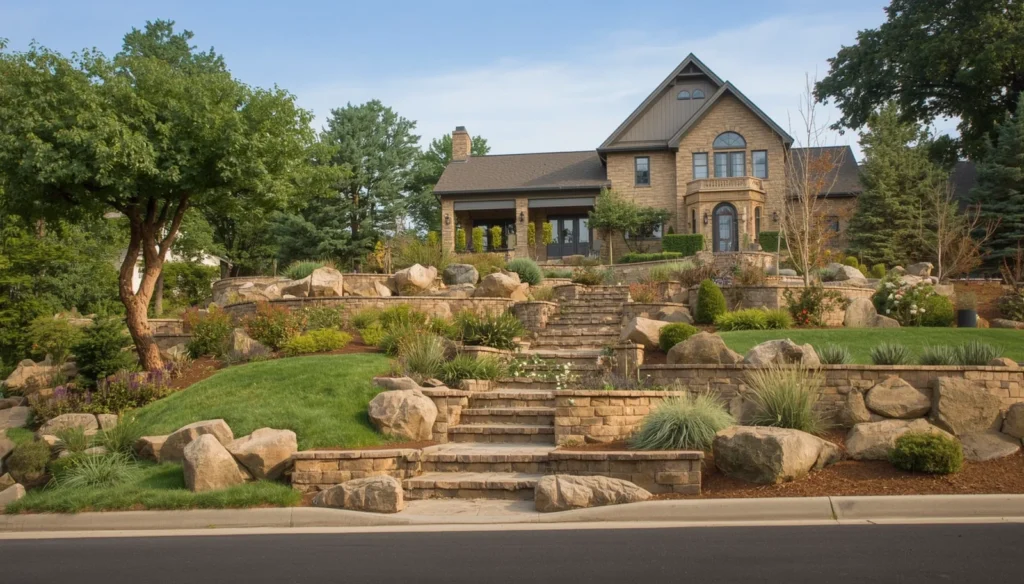
Slopes naturally emphasize focal points – a specimen tree, sculpture, or architectural element positioned on a slope commands attention more forcefully than on flat ground. Strategic focal point placement uses slope topography to maximum advantage. These features might be at the top of the slope (drawing the eye upward), at mid-slope (creating visual pause points), or at transitions between levels. Well-chosen and positioned focal points transform slopes from abstract landscape features into purposeful, designed spaces. Each focal point should have a reason for being there – perhaps marking a transition, highlighting a particularly beautiful view, or directing circulation.
Creating slope focal points begins with identifying natural visual stopping points or transitions. Select focal point elements that are interesting enough to justify their prominence – perhaps a dramatic plant, piece of art, water feature, or architectural element. Ensure focal points are visible from key vantage points – from your house, the street, and from within the landscape. Frame focal points with complementary plantings that direct attention without competing. Proper lighting can emphasize focal points and create nighttime drama. Strategic focal points transform slopes into sophisticated, intentionally designed landscapes.
19. Slope-Appropriate Plant Selection:
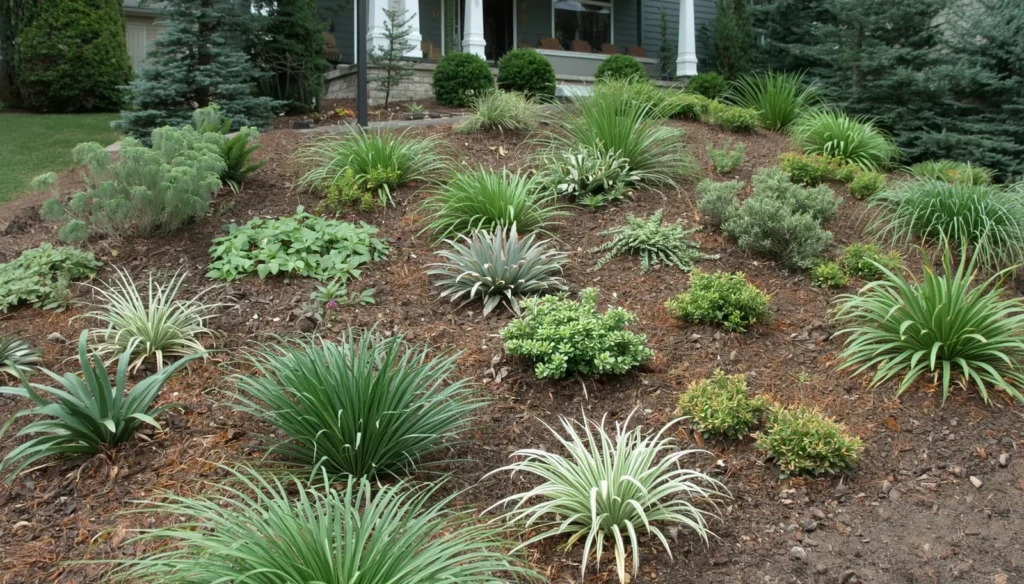
Slope success depends on selecting plants naturally adapted to slope conditions – deep-rooted specimens that stabilize soil, drought-tolerant varieties that handle poor moisture conditions, and robust plants that survive challenging slope environments. Rather than fighting slope conditions by trying to grow plants that prefer flat, irrigated areas, embrace slope reality by selecting plants that actually prefer these conditions. This approach creates healthier, more sustainable landscapes requiring less maintenance and supporting better outcomes.
Building slope plant selections requires understanding what plants naturally thrive on hillsides in your region. Many Mediterranean plants, regional natives, and deliberately selected cultivars actually perform better on slopes than on flat ground. Deep-rooted plants access water from deeper soil layers and stabilise slopes effectively. Drought-tolerant plants handle the characteristically drier conditions of slopes and often require less maintenance. Tough, robust plants survive challenging conditions while looking beautiful. Creating plant selections appropriate to slope conditions creates landscapes that thrive despite challenging conditions, looking increasingly healthy and established with time.
20. Slope Contouring With Subtle Grading:
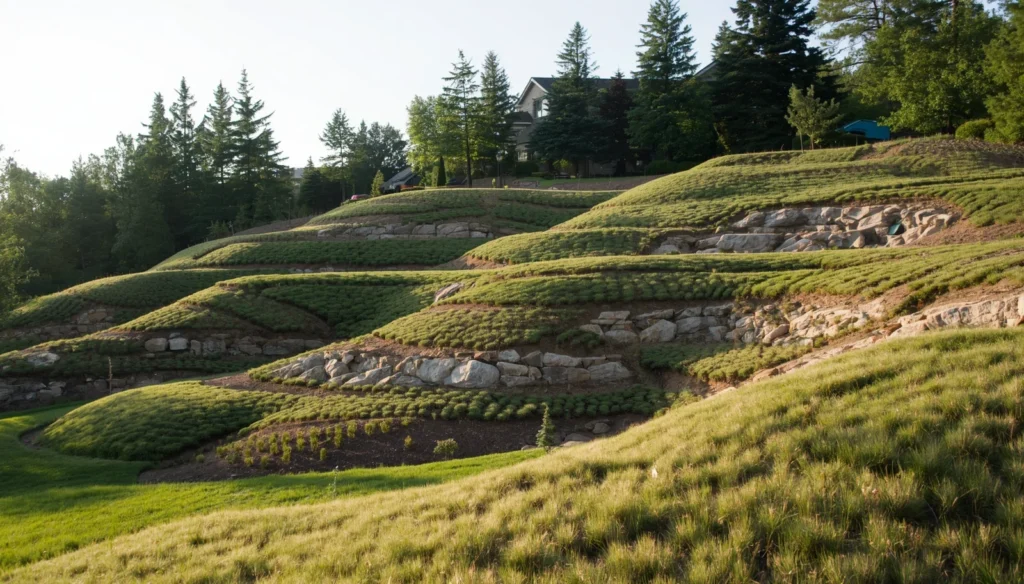
Master landscape designers use subtle grading and contouring to create flowing, organic-looking landscapes that feel naturally beautiful while being carefully designed. Rather than leaving slopes at uniform angles, subtle grading creates multiple slope angles that create visual interest and natural-looking complexity. Swales might follow natural water flow patterns. Berms might be created for visual interest or screening. These landform modifications are subtle – the landscape looks natural rather than engineered – yet they dramatically improve visual interest and function. Mastering contouring transforms adequate slopes into genuinely beautiful landscapes.
Implementing slope contouring requires vision and sometimes professional expertise to execute safely and beautifully. Work with a landscape designer if you’re unsure about grading approaches. Ensure that grading changes don’t create drainage problems or unsafe situations. Use plantings to emphasise contours – darker plantings might accent a subtle wales, while lighter plantings might highlight a berm. The resulting landscape feels organic and natural while being deliberately designed. A slope with sophisticated contouring appears infinitely more interesting than one with uniform grading, rewarding the effort invested in thoughtful land-form design.
21. Slope Mulching Strategies:
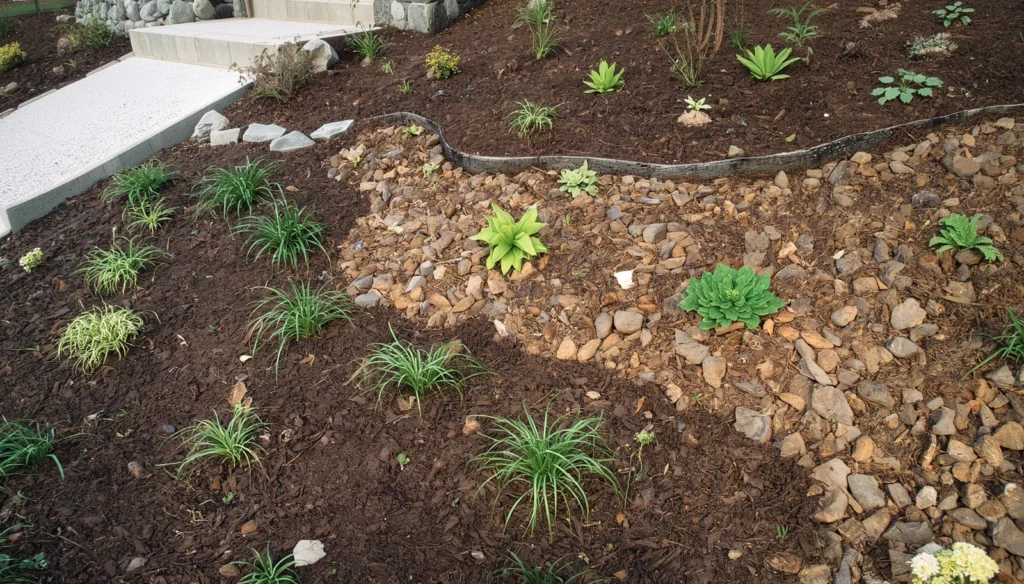
Proper mulching is essential for slope success – mulch prevents erosion by holding soil in place, moderates soil temperature, retains moisture, and improves soil over time as it decomposes. However, mulching slopes requires different approaches than mulching flat areas. Slope mulch should be deep enough to prevent erosion (3-4 inches typically) but not so deep that it buries plant stems. Mulch on slopes can wash downhill, requiring containment edges or strategic placement. Proper slope mulching is simultaneously practical problem-solving and contribution to plant health.
Implementing slope mulching begins with understanding your slope’s erosion potential. Steeper slopes may need containment edges to prevent mulch migration. Select mulch types appropriate to your slope – some materials hold in place better than others. Avoid fresh wood chips that might harbor pathogens; aged mulch is preferable. Mulch around plants rather than burying stems. Top-dress mulch annually to maintain depth and appearance. Proper mulching transforms slopes from erosion-prone areas into healthy, stable landscapes supporting thriving plantings.
22. Slope Integration With Hardscape Features:
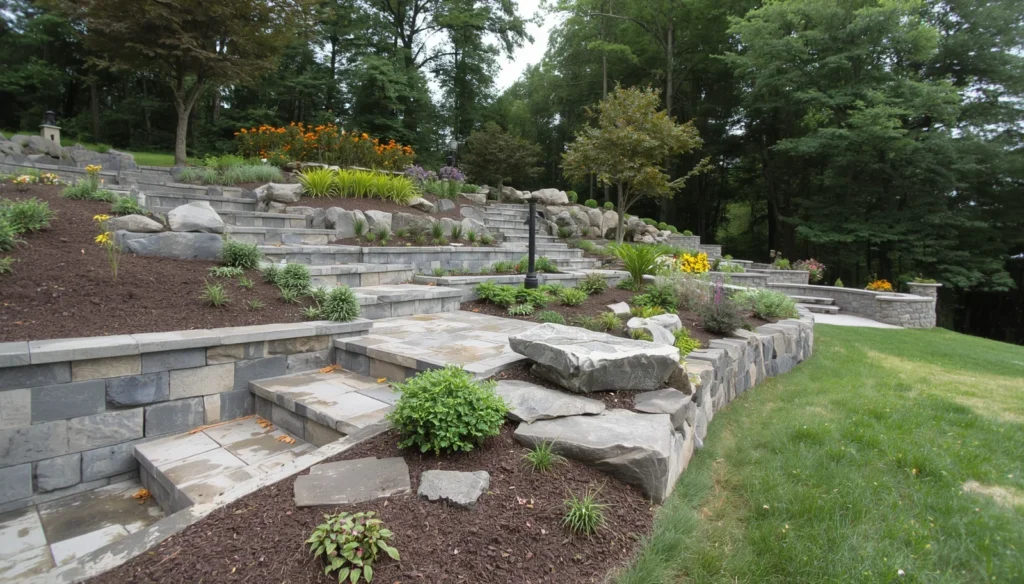
The most sophisticated slope designs view hardscape and natural landscape as integrated systems rather than separate elements. Retaining walls are softened with cascading plantings. Steps are lined with herbs or groundcovers. Patios are surrounded by lush plantings. Pathways are bordered with flowers and shrubs. This integration creates landscapes that feel both designed and natural, combining the stability and function of hardscaping with the beauty and life of plantings. Rather than creating stark, purely hardscaped slopes or purely planted areas, the most successful designs blend both approaches.
Creating integrated slope designs requires planning that considers both hardscape and planting simultaneously. Ensure hardscaping is properly engineered and stable. Plan plantings that enhance rather than hide or undermine hardscape. Use color, texture, and form in plantings to echo hardscape materials and colors. Create visual flow between hard and soft elements. The resulting landscapes appear professionally designed and actually function more successfully than purely hardscaped or purely planted approaches. Integration transforms adequate designs into genuinely beautiful landscapes that homeowners love and visitors admire.
FAQ’s:
Q1: Is it expensive to landscape a slope?
A: Slope landscaping costs vary tremendously depending on project scope and chosen approaches. Simple solutions like native plant communities might cost minimal amounts. More elaborate projects with extensive hardscaping cost more. However, slopes that are landscaped beautifully often cost less than comparable flat-yard improvements because the elevation itself provides visual drama. Start with budget-friendly approaches – native plants, strategic positioning – and add more elaborate features as budget allows. Professional planning can help prioritize investments for maximum impact.
Q2: What’s the best time of year to landscape a slope?
A: Spring is ideal for planting, as it allows establishment before summer heat. Fall is also good in many regions, providing mild temperatures and natural rainfall for establishment. Avoid planting during summer heat unless you can ensure regular watering. Hardscape installation can happen most times of year, though frozen ground complicates digging. Professional timing considerations might differ from DIY projects. Consult regional guidelines for your specific climate.
Q3: How do I prevent erosion on a steep slope?
A: Multiple strategies work together: dense plantings stabilize soil through root systems, mulch prevents raindrop impact, proper drainage directs water flow, and erosion control fabric temporarily stabilizes soil while plants establish. Avoid leaving bare soil exposed. Establish vegetation quickly through dense planting or direct seeding. Grade changes can direct water away from vulnerable areas. Consult professional advice for severely eroding slopes requiring engineered solutions.
Q4: Can I use decorative rock instead of mulch on slopes?
A: Decorative rock can work on slopes but requires careful selection. Heavy rocks stay in place better than light gravel. Rock doesn’t decompose to improve soil like mulch does, so plant health benefits are reduced. Rock can be attractive and durable. Consider combination approaches – mulch under plants, decorative rock in specific areas. Ensure rock doesn’t cause water drainage problems. Test durability in your climate.
Q5: Should slopes be completely planted or partially left open?
A: This depends on your aesthetic preferences and slope angle. Dense planting prevents erosion and looks more finished. Strategic open areas within plantings create visual interest and can showcase focal points or views. Entirely bare slopes usually look unfinished. Aim for thoughtful balance – dense plantings for stability, strategic breaks for interest and focal points.
Conclusion:
Stop viewing your front yard slope as a problem or limitation. Your hill is actually your landscape’s greatest opportunity – the feature that sets your property apart from flat yards, that creates drama and visual interest, that allows creative designs impossible elsewhere. Throughout this guide, you’ve discovered 22 proven approaches to transforming slopes from challenges into genuine assets. Whether you’re implementing simple native plantings, creating terraced gardens, installing water features, or combining multiple elements into comprehensive landscape transformations, you have the knowledge and inspiration to create something genuinely special.
Slope landscaping success comes from embracing rather than fighting your terrain, from understanding how water, soil, and plants naturally work on hillsides, and from thoughtfully combining elements into cohesive designs. Start with stabilization and drainage – the practical foundations. Add functional features that enhance usability – paths, steps, seating areas. Layer in beauty through thoughtful plantings, focal points, and design details. Include finishing touches – lighting, mulching, seasonal interest. Throughout the process, maintain perspective: every element should serve practical purposes while contributing to overall beauty. The result – a landscape where structure and nature work together, where every element justifies its presence, where visitors pause to admire – is worth every effort invested.