

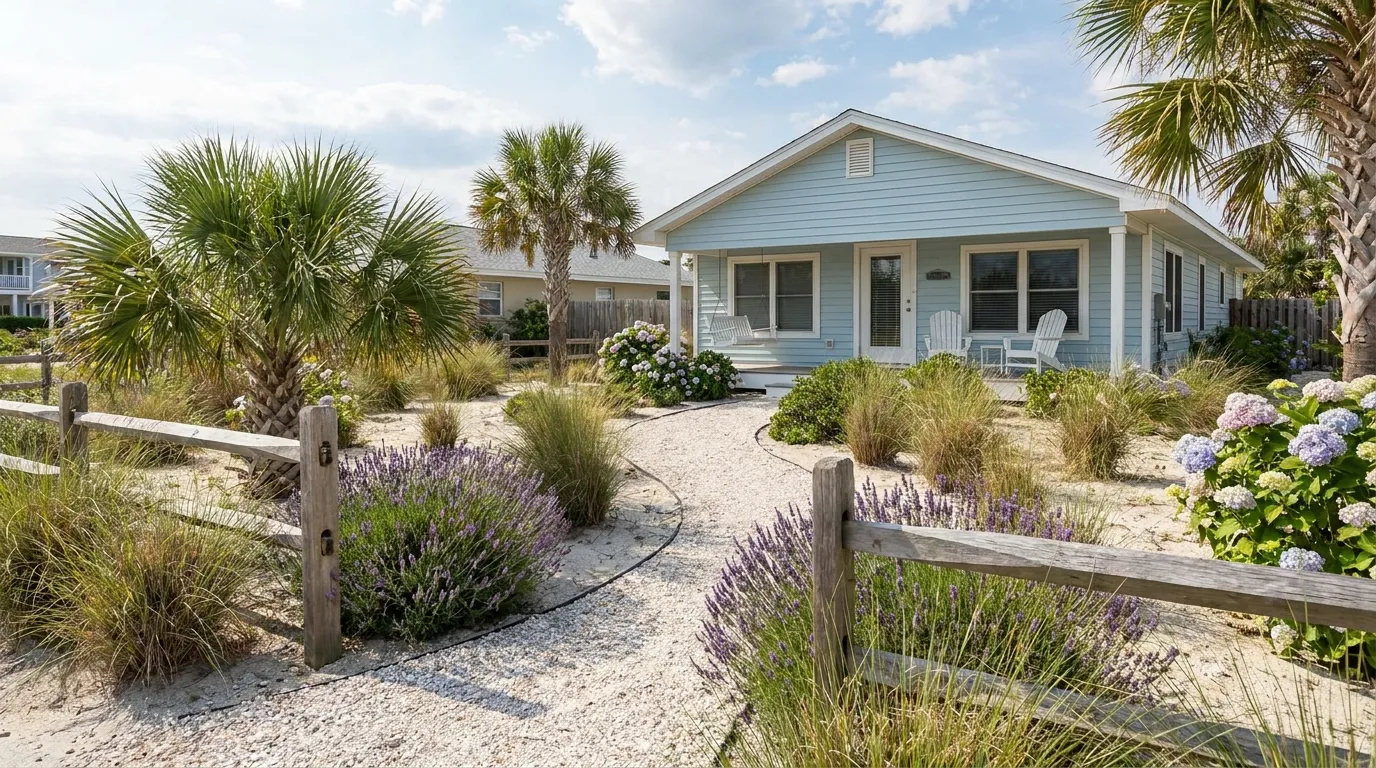
Transforming a dry front yard into a stunning landscape is easier than many homeowners think. Desert landscaping combines beauty, water efficiency, texture, and year-round visual interest. From decorative gravel and succulents to dramatic cacti and modern landscaping, these ideas can help create a welcoming entrance while keeping maintenance low. These landscapes are not only visually striking but also environmentally friendly, making them an increasingly popular choice for homeowners looking to reduce water consumption without sacrificing curb appeal.
1. Modern Gravel Garden:

A modern gravel garden trades thirsty turf for clean lines and rich texture. Start by removing grass and laying landscape fabric, then spread two to three inches of decomposed granite or pea gravel in a warm neutral tone. Use crisp metal or concrete edging to define geometric beds and keep gravel from migrating. Cluster sculptural succulents such as echeveria, blue agave, and barrel cactus in odd-numbered groupings for a contemporary look that stays sharp year-round.
Add contrast with dark river rock accents and a few large specimen boulders to anchor the design. A drip irrigation line hidden beneath the gravel keeps plants thriving with minimal water and almost no evaporation. Finish with low-voltage path lights along the walkway; at night, their glow across the stone creates striking shadows. This style suits ranch and mid-century homes especially well, delivering high impact with very little maintenance.
2. Cactus Showcase:

Turn your front yard into a living gallery by showcasing specimen cacti as art pieces. A towering saguaro or a multi-armed organ pipe cactus instantly becomes the centerpiece, framed by a bed of contrasting gravel. Underplant with low-growing golden barrel cacti and prickly pear pads to create layers of form without clutter. Give each large cactus plenty of space so its silhouette reads clearly from the street.
Plant cacti in spring so roots establish before winter, and always wear thick gloves and use tongs or carpet scraps when handling spiny specimens. A slow drip emitter at each plant’s base, run deeply but infrequently, encourages strong roots. Surround the display with decomposed granite rather than organic mulch, which can hold damaging moisture against cactus stems. The result is a bold, architectural front yard that thrives on neglect.
3. Succulent Border:

A succulent border lines your walkway or foundation with jewel-toned rosettes that need almost no water. Edge the bed with steel or stone, fill with fast-draining cactus mix topped by small gravel, and plant echeveria, sedum, aeonium, and haworthia in repeating drifts. Mixing blue-green, burgundy, and lime varieties creates a tapestry effect that changes with the seasons as colors intensify in sun and cool weather.
Space plants according to their mature size so the border looks full immediately but is not overcrowded in a year. A thin top dressing of crushed granite keeps leaves off damp soil and prevents rot. Water deeply every two to three weeks in summer and cut back in winter. Pull the occasional weed and remove spent leaves to keep rosettes tidy. This border gives cottage-garden charm with a fraction of the water a flower bed demands.
4. Desert Rock River:

A desert rock river is a dry streambed of smooth river stones that winds through the yard, suggesting the path water once took. Dig a shallow, meandering channel about six inches deep, line it with landscape fabric, and fill it with polished river rock in blues and grays. Larger boulders placed along the banks look like natural outcrops and give the composition a convincing, organic feel.
Beyond its beauty, a rock river is practical: it channels monsoon rain away from the foundation and prevents erosion on sloped lots. Plant desert marigold, penstemon, and blue palo verde along its edges so blooms spill toward the stones. A few stepping stones across the widest point turn it into an interactive feature. Maintenance is minimal — just rake the stones smooth after heavy storms.
5. Agave Focal Point:

Few plants command attention like a mature agave. Century plants, blue agaves, and artichoke agaves form perfect sculptural rosettes up to six feet wide, making them ideal single-specimen focal points near the entry or at the corner of the house. Set the agave in a raised mound of gravelly soil for sharp drainage, and surround it with a ring of smaller stones that echo its color.
Choose a variety suited to your space: compact ‘Blue Glow’ for tight spots, massive Americana for drama. Agaves need almost no water once established and never need pruning — simply remove the occasional pup to keep the form clean. Note that most agaves bloom once and die, but pups carry on the display. Pair with warm uplighting to make the rosette glow after dark.
6. Layered Stone Beds:

Layered stone beds build visual depth by stacking retaining walls of natural flagstone or ledgestone into two or three tiers. Each level becomes its own planting zone: tall ocotillo and red yucca on the top tier, mid-size lantana and salvia in the middle, and trailing ice plant or verbena spilling over the lowest wall. The stonework itself adds craftsmanship and permanence to the design.
Dry-stack walls or mortared stone both work; just include drainage gravel behind each wall so water never builds up. Fill beds with a sandy, fast-draining mix and top with crushed rock mulch. Terracing is especially smart on sloped front yards, where it stops erosion and creates usable planting space. The layered look reads as intentional and high-end while using entirely drought-tolerant plants.
7. Palm and Gravel Design:

Palms bring instant resort style to a desert front yard, and they pair beautifully with gravel mulch. Mediterranean fan palms and date palms tolerate heat and need far less water than lawns once established. Plant a single statement palm near the entry or a staggered trio along the property line, then carpet the ground beneath with warm-toned decomposed granite raked into gentle waves.
Keep palm trunks clear of gravel piled against them, and run a dedicated drip line with several emitters in a ring around each root zone. Underplant with low succulents like agave parryi or desert spoon so the base never looks bare. Trim dead fronds once a year and remove seed pods to keep the look clean. The combination delivers shade, movement, and a vacation vibe with modest water use.
8. Native Plant Garden:

A native plant garden celebrates the Sonoran and Chihuahuan desert palette with plants that evolved for your exact climate. Brittlebush, creosote, desert marigold, penstemon, and globe mallow thrive on rainfall alone once established, while providing nectar for hummingbirds, bees, and butterflies. Arrange them in naturalistic drifts rather than formal rows to mimic the surrounding desert.
Because natives are adapted to local soils, they need no fertilizer and little pruning — just a yearly cleanup of spent seed heads. A light mulch of crushed native rock keeps the look authentic and suppresses weeds. Group plants with similar water needs and expect the garden to look sparse the first year; by year three it will be lush and self-sustaining. This is the lowest-maintenance, most ecologically valuable option on the list.
9. Decorative Boulders:

Decorative boulders give a desert landscape instant geology and structure. Choose two or three large stones in a local granite or sandstone — ideally partially buried so they look naturally unearthed rather than placed. Odd-numbered groupings read as natural; vary the sizes and tilt each boulder so its most interesting face shows. Set them first, then plant around them.
Boulders do real work: they retain heat that warms nearby plants on cold nights, provide habitat for lizards, and anchor the composition so plantings feel intentional. Nestle low succulents, grasses, and wildflowers at their bases, leaving the stone faces exposed. A boulder cluster beside the walkway or flanking the driveway creates a strong sense of arrival without a single drop of extra water.
10. Desert Pathway:

A desert pathway guides visitors through the landscape while showing off its materials. Flagstone slabs set in decomposed granite make a classic choice: space the stones for a comfortable stride and fill the gaps with compacted granite that stays firm underfoot. Alternatively, a simple raked gravel path edged with steel creates a clean modern line from sidewalk to front door.
Lay landscape fabric beneath the path to block weeds, and crown the surface slightly so monsoon rain sheets off. Line the route with low plantings — dwarf lantana, trailing rosemary, or small agaves — that will not overgrow the walkway. Solar or low-voltage lights tucked beside the path make it safe and dramatic at night. A well-built path ties the whole front yard together and handles foot traffic without wear.
11. Raised Succulent Beds:

Raised beds lift succulents to eye level, improving drainage and turning the planting into a feature. Build low walls from stuccoed block, corten steel, or stacked stone — twelve to eighteen inches high is plenty — and fill with a gritty cactus mix. The elevation shows off rosette forms beautifully and keeps cold air from pooling around frost-tender varieties.
Plant a tapestry of echeveria, crassula, sedum, and aeonium, letting trailing varieties spill over the wall edges. Raised beds warm up faster in spring and drain instantly after rain, which succulents love. A drip line on a timer makes watering effortless. Place a raised bed flanking the front steps or along the driveway, and it becomes a living sculpture that anchors the entry.
12. Southwestern Style Yard:

A Southwestern style yard draws on adobe, terracotta, and native plants for regional character. Warm stucco walls or a low adobe garden wall set the stage; fill beds with crushed red rock or decomposed granite, then plant ocotillo, prickly pear, desert willow, and lantana. Terracotta pots clustered by the door add height and a handcrafted feel.
Details make this style sing: a hand-painted Talavera tile inset in a step riser, a rustic wooden gate, or a chiminea tucked into a gravel patio corner. Stick to a warm, earthy palette — rust, sand, turquoise accents — and let native plants do the heavy lifting. The result feels rooted in place, welcoming, and unmistakably of the Southwest.
13. Colorful Desert Blooms:

Desert gardens can blaze with color if you choose the right bloomers. Desert marigold, penstemon, globe mallow, Mexican bird of paradise, and desert willow flower for months on very little water. Plant them in bold sweeps near the street and entry where the color reads from a distance, mixing heights so blooms layer from spring through fall.
Deadhead spent flowers to extend the show, and give bloomers a deep soak every week or two in the hottest months — far less than a lawn needs. Many desert wildflowers self-sow, returning thicker each year. Pair flowering plants with silver-leafed companions like Texas sage or artemisia so the colors pop against cool foliage. A bloom-focused yard proves xeriscaping is anything but brown.
14. Minimalist Desert Design:

Minimalist desert design uses restraint as its luxury: a sea of pale gravel, one sculptural tree, and a handful of perfectly placed plants. A single multi-trunk palo verde or sculptural ironwood becomes the star, underplanted with just a few agaves or a drift of ornamental grass. Negative space is the point — every element earns its place.
Keep the palette tight: one gravel tone, one or two plant colors, clean steel edging. Rake gravel into subtle patterns for a zen-garden feel, and hide all irrigation below the surface. This style suits modern architecture perfectly and is the easiest of all to maintain — there is simply less to tend. Done well, it feels calm, expensive, and timeless.
15. Dry Creek Bed:

A dry creek bed solves drainage problems while looking like a natural arroyo. Carve a shallow, winding swale through the yard, line it with river rock, and edge it with native grasses and wildflowers. During monsoon season it carries runoff gracefully away from the house; the rest of the year it is a sculptural ribbon of stone winding through the plantings.
Size the channel to your roof runoff — wider and deeper where downspouts discharge. Bridge it with a flat stone slab or small wooden footbridge for charm. Plant moisture-loving natives like desert willow and canyon hackberry nearby, and keep drought-tolerant plants on the higher banks. It is functional infrastructure disguised as landscape art.
16. Desert Courtyard Entry:

A desert courtyard entry turns the walk to your front door into an experience. Low stucco or stone walls enclose a gravel forecourt planted with sculptural agaves, a small olive or citrus tree, and pots of colorful annuals. A simple fountain or bubbling urn adds the sound of water — precious and delightful in the desert — without the waste of a lawn.
Keep walls at sitting height so the space feels open, not fortress-like, and pave a clear path wide enough for two people. Shade from a palo verde or a modern shade sail makes the courtyard usable on hot afternoons. String lights or lanterns overhead turn it into a magical evening spot. This entry style adds privacy, charm, and real living space to the front of the home.
17. Mixed Texture Landscape:

Mixed texture landscape design plays the desert’s surfaces against each other: spiky agave beside feathery grasses, smooth river rock against rough bark, fine gravel meeting chunky boulders. The contrast makes each plant look more dramatic. Combine architectural yucca and ocotillo with soft Mexican feather grass and trailing lantana for a composition that rewards close looks.
Plan textures in layers: bold structural plants as anchors, medium mounding shrubs to fill, and fine-textured grasses to knit it together. A limited color palette keeps the variety from feeling chaotic. Step back to the curb while planting to check the balance — texture reads from a distance too. This approach gives the richest, most sophisticated look of any desert style.
18. Desert Lighting Display:

Desert lighting transforms the front yard into a nighttime showpiece. Uplight sculptural cacti and multi-trunk trees so their forms cast dramatic shadows on walls and fences. Path lights guide visitors safely along walkways, while small spotlights grazed across boulders reveal texture invisible by day. Warm 2700K LEDs flatter both plants and architecture.
Use a low-voltage system with a timer or smart transformer so lights run only in the evening hours. Bury cables under gravel and use brass or copper fixtures that patina beautifully. Highlight one hero specimen per viewing angle rather than flooding everything with light — restraint reads as luxury. Good lighting extends your curb appeal around the clock and improves security too.
19. Terraced Front Yard:

A terraced front yard turns a sloped lot from a problem into the property’s best feature. Two or three retaining walls of natural stone or interlocking block create level planting platforms, each with its own character: a cactus garden on top, flowering perennials in the middle, and groundcover spilling over the lowest wall. The structure itself adds architecture and value.
Build walls with proper drainage — gravel backfill and weep holes — so monsoon rains pass through instead of pushing walls over. Drip irrigation on each terrace runs efficiently since water soaks in rather than running off. Wide, shallow steps between levels double as seating. Terracing ends erosion, creates usable garden space, and makes a hillside home look custom-built for its site.
20. Drought Tolerant Ground Cover:

Drought tolerant ground covers replace thirsty lawn with living carpet that sips water. Trailing lantana, verbena, ice plant, and silver ponyfoot spread quickly, smother weeds, and bloom for months. For a lawn-like look, buffalograss or blue grama stays green with a fraction of the water Bermuda demands and needs mowing only monthly.
Prepare the area by removing old turf, amending lightly, and installing drip lines or soaker tubing before planting. Space ground covers on twelve-inch centers for quick fill-in, and mulch between plants with fine gravel. Most need only occasional deep watering once established. The result is soft, green, walkable ground that cuts your water bill dramatically while staying easy on bare feet.
FAQs:
What are the best plants for desert landscaping?
Succulents, agave, yucca, cacti, and native drought tolerant shrubs are excellent choices.
How often should desert landscapes be watered?
Most established desert plants require significantly less water than traditional lawns.
Is desert landscaping low maintenance?
Yes, especially when using gravel, rock mulch, and drought tolerant plants.
Can desert landscaping increase property value?
Yes, a well designed desert landscape can enhance curb appeal and make a property more attractive to potential buyers. Low maintenance outdoor spaces and water efficient designs are especially appealing in regions with hot and dry climates.
What is the best mulch for a desert front yard?
Rock mulch, decomposed granite, and decorative gravel are among the best options for desert landscapes. These materials help reduce water evaporation, suppress weeds, and complement the natural beauty of drought tolerant plants.
Conclusion
These desert front yard landscaping ideas demonstrate how beauty and practicality can work together. By combining drought tolerant plants, attractive landscaping, and thoughtful design, homeowners can create an eye catching front yard that conserves water and remains attractive throughout the year. By combining drought tolerant plants with decorative rocks, pathways, lighting, and landscape features, homeowners can create a landscape that remains attractive throughout every season while requiring far less maintenance than a traditional lawn.